
How to Check Criminal History in Emmaus
Start with the kind of proof needed. Emmaus Police records are the direct source for an Emmaus borough incident, while an official Emmaus release confirms what the Police Department published for a recent period. Neither source supplies a complete Pennsylvania history. A filed Emmaus case belongs in the Unified Judicial System, and a repository check comes from Pennsylvania State Police. This order keeps an Emmaus search tied to the office that made the record.
- Review the Emmaus Police press-release page for the relevant weekly or biweekly period and note the incident details that can narrow a request.
- Submit the Emmaus Police form when the full incident or accident report is the goal. Give the date, type, and location as precisely as possible.
- Search the official UJS Case Search by participant, OTN, or police incident and complaint number, with Lehigh selected as the county.
- Contact the Lehigh County court clerk when a public docket is not enough or a certified court copy is needed.
- Use PATCH for a Pennsylvania repository certificate, or the subject-only Access and Review process when checking and correcting one’s own full state record.
The sequence may stop after one step. A person who needs a crash report has no reason to order a court file. Someone tracing the result of an Emmaus arrest should continue to the docket, since the police release states the accusation and the court records the disposition, meaning the way each charge was resolved.
Emmaus Police Arrest Releases
Emmaus uses a small-borough publication model. The Emmaus Police Department posts official weekly or biweekly reports with adult and juvenile arrest information as law permits, counts, incident categories, totals, and found-property notices. This mix makes the Emmaus page a community police bulletin, not a searchable rap-sheet database. A date range may be more useful than a name when reviewing the Emmaus record stream.
The Emmaus borough arrest and incident release page is shown below. It is the right source for checking what Emmaus Police officially released, not for guessing at facts omitted by law.
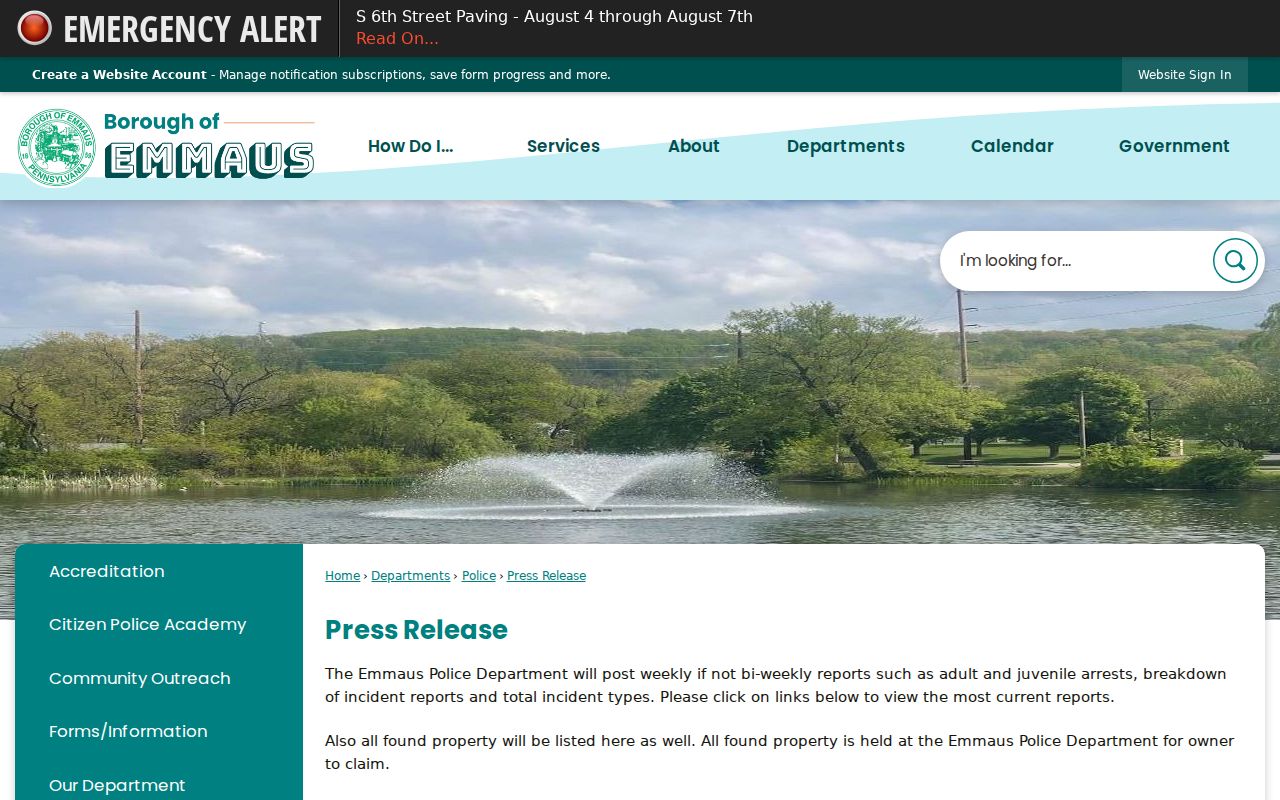
The Emmaus release archive gives local context and a publishing date. A later court search is needed to learn whether charges were withdrawn, dismissed, amended, or resolved.
The Emmaus Police Department
The Emmaus Police Department is at 400 Jubilee Street, Emmaus, PA 18049. Its files begin with calls, incident reports, accident reports, and arrest paperwork made by Emmaus officers. Emmaus Police decides what can be released under Pennsylvania law. An active investigation, juvenile privacy, victim details, or evidence-sensitive facts can lead to a denial or redaction. A redaction hides protected parts while leaving releasable parts visible.
Emmaus is legally a borough, not a city. The Emmaus Police Department is a borough agency, while the Court of Common Pleas, county jail, and Clerk of Judicial Records are Lehigh County functions. The Pennsylvania State Police Central Repository is a state function. One broad Emmaus request will not make those other offices produce separate records.
Emmaus Police Department
400 Jubilee Street
Emmaus, PA 18049
Request Emmaus incident and accident reports through the Emmaus Police record channel.
For Emmaus Police audio or video, Pennsylvania Act 22 applies instead of the ordinary Right-to-Know route. Identify the approximate time, date, place, incident, and agency because the rules differ from a paper request.
Emmaus Criminal Report Fees
The Emmaus Police request form states two clear prices: $10 for incident-report information and $15 for accident-report information. These are separate Emmaus report products. The fees do not buy a statewide check, certified court docket, or inmate record. Naming the right Emmaus report helps staff route the request and apply the listed fee.
| Emmaus record | Listed fee | Best use |
|---|---|---|
| Incident-report information | $10 | A specific event handled by Emmaus Police |
| Accident-report information | $15 | A specific crash record handled by Emmaus Police |
An official Emmaus release and a paid Emmaus report are not the same item. The release sums up selected activity. The report request seeks an existing Emmaus agency record, and the response may omit facts protected by law. The Emmaus form does not promise that each named record is public.
Arrests and Bookings in Emmaus
An Emmaus arrest starts several records. An Emmaus officer creates the incident or arrest report. Fingerprints and an Offense Tracking Number, known as an OTN, connect the event to the state repository and courts. Central booking records identity and charges. A preliminary arraignment addresses bail and scheduling. Each system holds a distinct part.
Emmaus does not operate a long-term borough jail. Emmaus custodial bookings enter the Lehigh County corrections and central-booking structure. No verified open county inmate roster was found, so a missing web result cannot prove release or lack of custody. Direct official contact and the court docket are the fallback channels.
For a broader explanation of county custody sources and the booking trail, the Lehigh County arrest history resource separates police, jail, court, and state records. The PA Department of Corrections locator should only be used after state commitment or for a state-supervised parolee. It expressly excludes county-jail custody.
Note: An Emmaus arrest is an allegation, and only the court docket can show the later result of each filed charge.
Emmaus Police Request Form Fields
The Emmaus form asks for enough facts to find one event without forcing Emmaus staff to create a new report. A clear Emmaus request describes an existing record. It does not ask Emmaus Police to research a person’s life or compile answers that the agency does not maintain.
The Pennsylvania Office of Open Records explains the statewide Right-to-Know framework reflected in local request practice. The image below provides official state context for records requests and appeals.
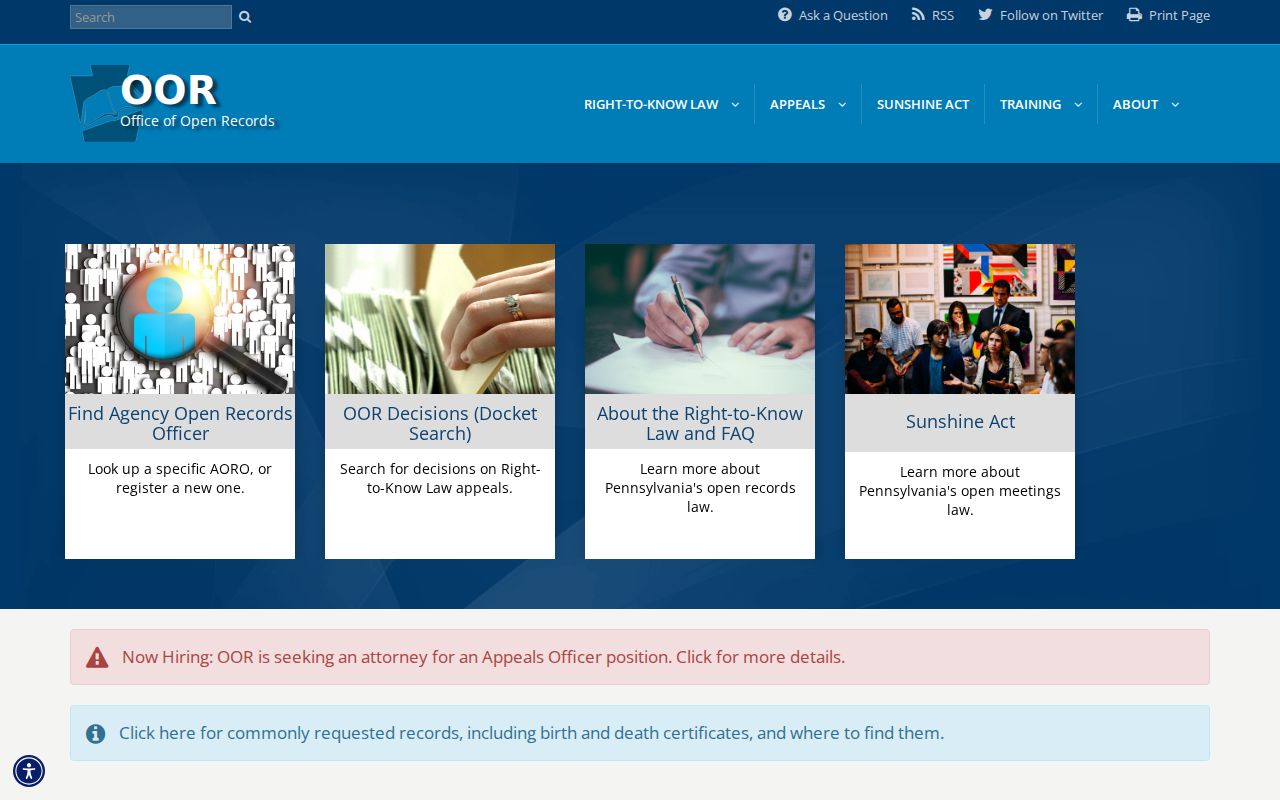
That state framework supports the Emmaus form, but Emmaus Police still decides the first response to Emmaus records. The form calls for these event and requester details:
- requester’s printed first name, middle initial, and last name;
- request date, mailing address, and telephone number;
- incident date, incident type, and incident location;
- the person arrested, if known; and
- the requester’s signature.
Emmaus office fields record identification, the date received, and whether access is granted, denied, or under review. A date, type, and place can be more reliable than a common name, even if the requester does not know who was arrested.
Emmaus Municipal Court Records
Emmaus has no general trial court and no separate municipal criminal-case database. “Municipal court records” points to Pennsylvania courts that handle Emmaus matters. An Emmaus case starts in the assigned Magisterial District Court. A felony or misdemeanor held for court moves to the Lehigh County Court of Common Pleas, Pennsylvania’s 31st Judicial District.
| Court Structure | Assigned Magisterial District Court, then Lehigh County Court of Common Pleas when a case is held for court |
|---|---|
| Case Types | Summary matters and preliminary proceedings at the district level; held-for-court felony and misdemeanor cases at Common Pleas |
| Lookup Channel | Unified Judicial System of Pennsylvania Web Portal Case Search |
| Docket Details | Docket number, OTN, charges, grade, bail, events, disposition, sentence, and costs when public |
| Copies | Public court papers and certified copies through the Lehigh County Clerk of Judicial Records Criminal Division |
Search by participant, OTN, or police incident and complaint number, and choose Lehigh County. An OTN links stages of a criminal matter and is often safer than relying on a common name. A docket entry may be public even when the underlying document is not downloadable, while sealed and limited-access cases do not appear in the public search.
Emmaus Arrest Release Versus Report
Two Emmaus Police sources describe an event at different depth. The Emmaus release gives public notice and sums up selected activity. A requested Emmaus incident report is an agency file for one event. It may add a narrative, location, property or evidence details, and participant roles, but lawful redactions can narrow the result.
| Point | Official release | Incident report |
|---|---|---|
| How obtained | Read on the Emmaus borough site | Submit the Emmaus Police request form |
| Scope | Weekly or biweekly activity selected for publication | One identified police event |
| Depth | Counts, categories, and permitted arrest details | Potentially fuller agency narrative, subject to redaction |
| Case result | Not a final court disposition | Not a final court disposition |
Neither Emmaus product is a rap sheet. Pennsylvania criminal history information compiles identifiable arrest, charge, and disposition data. An Emmaus bulletin does not gather that full timeline. Pair the Emmaus source with the UJS docket to see the first allegation and later court outcome.
Where Emmaus Records End Up
Records leave Emmaus borough hands in stages, but the Emmaus file does not vanish. Emmaus Police retains its source report under police-record rules. Fingerprint and charge identifiers may go to the Pennsylvania State Police Central Repository. The assigned court opens the first Emmaus docket, and held-for-court cases move to Lehigh County Common Pleas. Courts report dispositions to the repository.
Record flow: Emmaus Police Department › Lehigh County Courts › Pennsylvania State Police Central Repository
This flow explains why Emmaus dates can differ across systems. A fresh Emmaus release may appear before a public docket is easy to find. A court can post a dismissal before the repository matches it to the arrest cycle. For one’s own record, compare the Emmaus incident reference, UJS docket, and subject-only state Access and Review.
The full filed case and sentence history belong in Lehigh County criminal court case records, not in the police release. Certified disposition papers from the clerk can also support a PSP challenge when state information is wrong or incomplete.
Emmaus Record Signature Warning
The Emmaus form places legal weight on the requester’s signature. Its warning cites 18 Pa.C.S. §§ 4903 and 4904, the Pennsylvania provisions for false swearing and unsworn falsification to authorities. In plain terms, signing is not a casual step. The requester should give true identifying and event details and should not claim knowledge that they do not have.
- False swearing
- A false statement made under a form of oath when the law treats the statement as sworn.
- Unsworn falsification
- A knowingly false written statement made to mislead a public servant in an official function.
- Under review
- An office status showing that access has not yet been finally granted or denied.
Unknown facts should not be guessed. The Emmaus form treats the person arrested as an “if known” field. Date, type, and location details can let Emmaus Police find the event. A careful Emmaus request also makes a later denial or appeal easier to understand.
Emmaus Criminal Records in PA UCR
The official Pennsylvania Uniform Crime Reporting portal supplies standardized Emmaus agency statistics. Use the Emmaus Police filter and a complete report year before comparing Emmaus results. Labels matter. An incident, offense, arrest, and victim are different units, so one count cannot replace another.
PA UCR is best for local context, not for finding a person’s Emmaus criminal history. It can show patterns in the borough’s reported activity while the Police Department release supplies a dated narrative snapshot. The UJS docket supplies case-level court information. No exact current Emmaus count is reproduced here because the interactive state source updates and the research did not capture a stable final-year table.
That restraint prevents a partial period from being compared with a full year. It also preserves the borough distinction: Emmaus figures should not be blended into Allentown totals or the whole of Lehigh County. Each is a different reporting unit with its own agency filter and population base.
Public Access Rules
Pennsylvania access rules depend on the Emmaus record. The Right-to-Know Law applies to qualifying Emmaus borough records, but its criminal-investigative exemption can protect Emmaus Police material. Criminal history compilations follow the Criminal History Record Information Act. Court dockets follow judicial access policies, not an ordinary Emmaus request. Police audio and video use Act 22.
Key Statutes:
Pennsylvania Right-to-Know Law governs requests for qualifying borough records, while 65 P.S. § 67.708(b)(16) protects criminal-investigative records.
18 Pa.C.S. §§ 9102 and 9121 define criminal history record information and set dissemination rules.
18 Pa.C.S. §§ 4903 and 4904 are the false-statement provisions cited by the Emmaus Police request form.
A denial is not proof that no Emmaus record exists. Emmaus may redact investigative facts, juvenile material, victim details, or another protected category. The Emmaus form’s granted, denied, and review choices reflect that screening. Ordinary Right-to-Know appeals go to the Pennsylvania Office of Open Records, while criminal-investigative appeals go to the Lehigh County District Attorney’s designated officer.
Public court access has limits too. Sealed and limited-access matters are absent from the public UJS interface. A person reviewing their own Emmaus criminal record should use the proper court or PSP correction route rather than assuming an online gap erased every agency copy.