
How to Check Criminal History in Allentown
Begin with the Allentown event, not a broad name query. An Allentown police incident report answers different questions from an Allentown court docket or a Pennsylvania State Police certificate. A recent Allentown complaint may still be with the Allentown Police Department. Once charges are filed, the Unified Judicial System carries the public docket. If custody is the question, Lehigh County Jail is the local facility, but it has no verified public roster. A full Pennsylvania repository check belongs with Pennsylvania Access To Criminal History, known as PATCH. Keeping those Allentown files separate prevents a police allegation from being read as a final court result.
- Ask Allentown Police Records for an ordinary report when the requester is named in it and meets the city's identification rules.
- Use the city Solicitor's Right-to-Know channel for arrest reports, investigative supplements, or other records outside the ordinary counter process.
- Search the official UJS Case Search by participant, OTN, or police complaint number, choosing Lehigh and the right court level.
- Contact Lehigh County Jail for current local custody, then use county court records to follow the filed case.
- Use Pennsylvania State Police PATCH for a statewide name-based certificate or the subject-only Access and Review process for one's full repository file.
For deeper county context, the Lehigh County criminal history overview explains how these Allentown city, court, jail, and state channels fit together.
Allentown Records at College Street
Allentown Police Records serves the public at the College Street side of the Public Safety Building, 425 Hamilton Street, Allentown, PA 18101. Public records hours are Monday through Friday, 8:00 a.m. to 3:30 p.m. A separate reporting entrance remains open around the clock. That split matters. The 24-hour door is for speaking with an officer or making a report, while the daytime records counter handles eligible copies already held by the unit.
An Allentown requester named in an ordinary report may obtain a copy for $15 with government photo identification. Counter payment may be cash, personal or business check, or money order. Allentown Police Records can be reached at 610-437-7709, extensions 2314, 2312, or 2227. The Allentown police desk is 610-437-7753. Before going downtown, confirm that the requested Allentown item is an ordinary report. Arrest reports and investigative supplements follow the Allentown Solicitor's public-record route instead.
The Allentown Police Department
Allentown Police Records receives, processes, classifies, distributes, stores, secures, and expunges Allentown department reports. It also maintains criminal history record information for people arrested and fingerprinted by APD. These duties make the unit the best Allentown source for an Allentown incident narrative, but not for every later result. Court clerks hold the Allentown case file after charges reach court, and Pennsylvania State Police maintains the central criminal-history repository.
The official Allentown Police Department page identifies the local department and its current service routes.
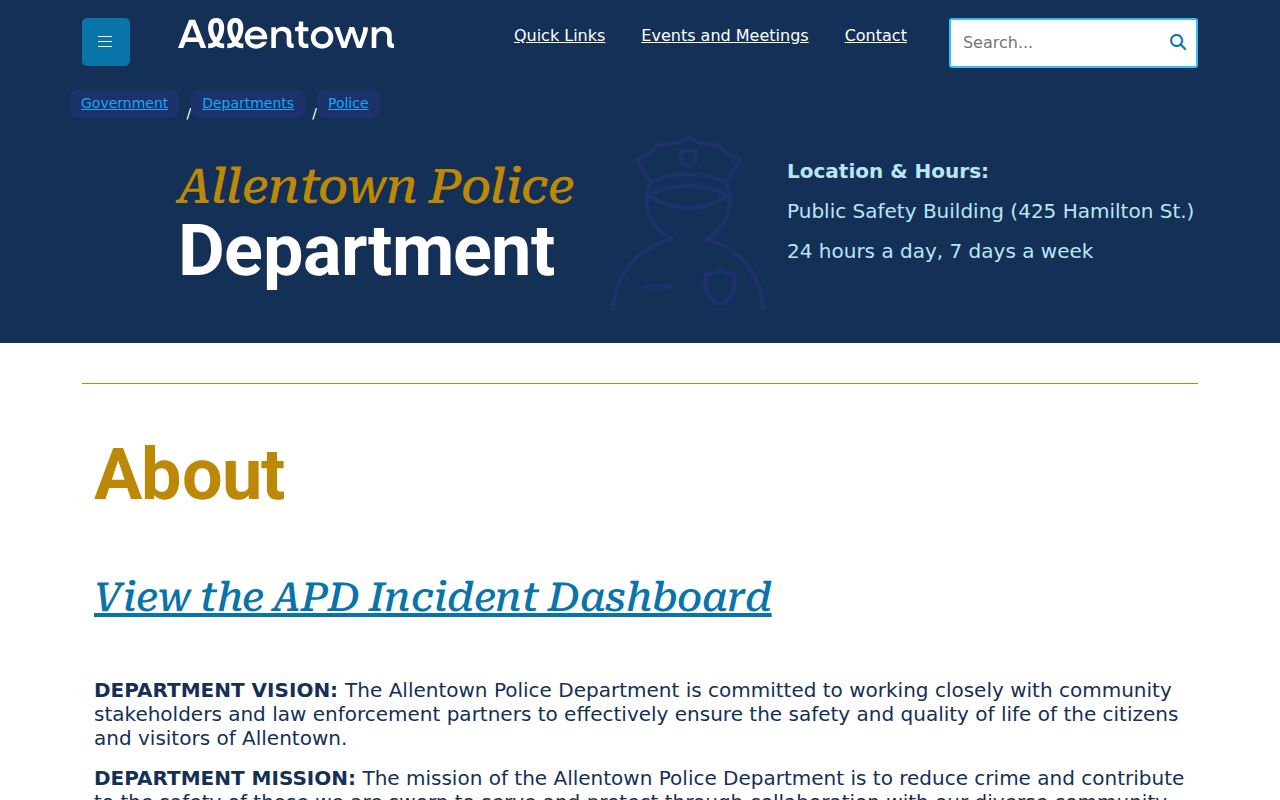
The department source helps a reader locate APD services without mistaking a city police record for a county court file or statewide record.
Allentown Incident Dashboard
APD's public incident dashboard is an Allentown context tool. Launched in May 2025, it covers Allentown incidents from January 1, 2024 forward and refreshes nightly around midnight. Allentown locations are mapped to the nearest street intersection rather than an exact address. That design supports Allentown neighborhood and trend research while reducing the risk of treating a map point as a complete account of an event.
The city's official Allentown incident dashboard announcement explains the source, date range, map treatment, and update cycle.
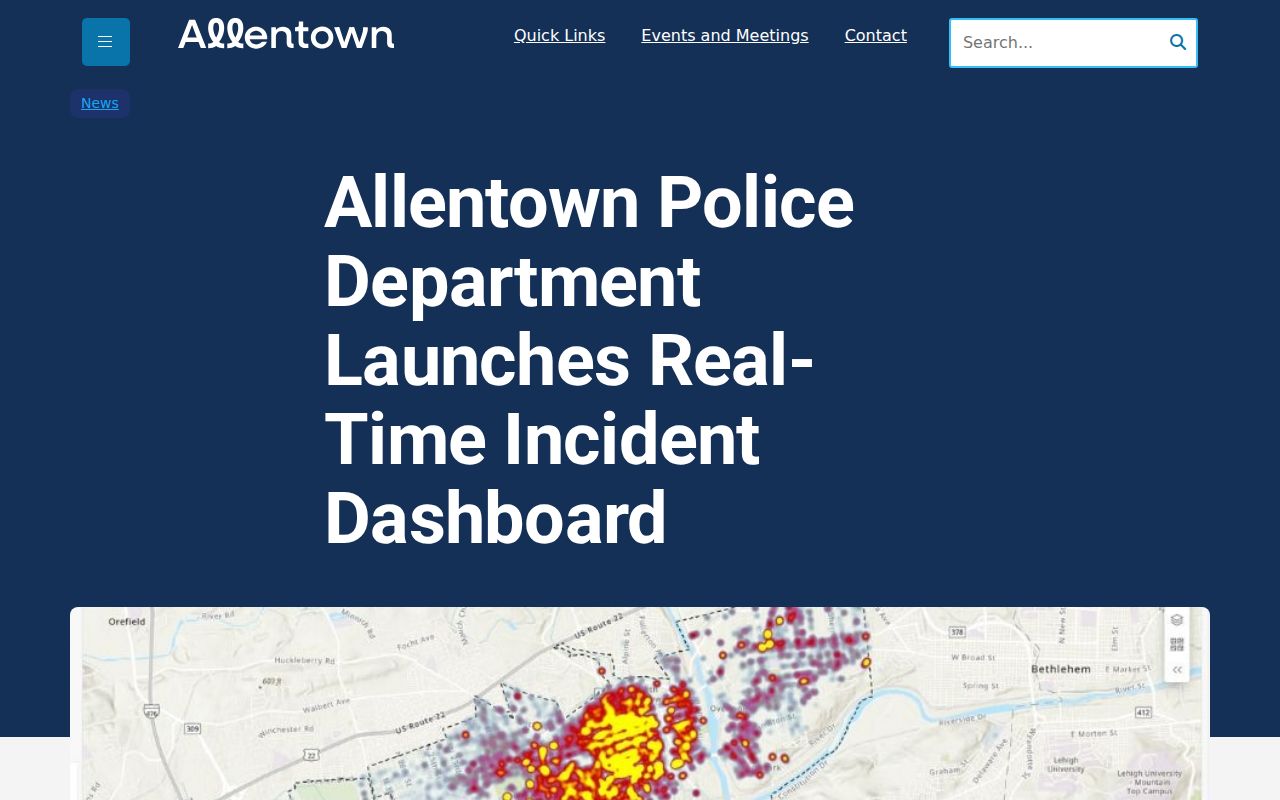
The image shows why the dashboard belongs beside an Allentown records search, yet it cannot prove that a person was arrested, charged, or convicted.
| Allentown source | What it answers | What it does not prove |
|---|---|---|
| Incident dashboard | When and near where APD incidents were logged | An individual's arrest or case outcome |
| Police report | Eligible incident details held by APD | A final judicial disposition |
| UJS docket | Filed charges, events, and disposition | The full police investigation |
Arrests and Bookings in Allentown
An Allentown APD arrest begins several records. The officer creates the Allentown incident or arrest report. Fingerprints and the Offense Tracking Number connect the Allentown event with the Pennsylvania State Police and court systems. Central booking records identity and charges, and a preliminary arraignment addresses bail and scheduling. If the person remains in local custody, the Lehigh County Jail at 38 N. Fourth Street keeps the jail record. Allentown APD does not operate the county jail.
Lehigh County has no verified public online booking roster. For current custody, use the jail's official contact channel rather than an unofficial name site. For the filed complaint and later result, search UJS by OTN, participant, or police incident number. The dedicated Lehigh County arrest history resource covers the county jail, custody, and arrest-record channels in more depth.
Timing can create gaps in Allentown records. A person may be released before the Allentown court docket is easy to find, and a new disposition may take time to reach the state repository. One missing Allentown result should prompt a second official source, not a conclusion that the event did not occur.
Allentown Arrest Reports and RTKL
Allentown's $15 counter rule does not turn every APD file into an ordinary walk-in record. The city directs arrest reports and investigative supplements to the Solicitor's Right-to-Know clerk. Requests may be sent to right-to-know@allentownpa.gov, faxed to 610-437-8701, mailed to City of Allentown, ATTN Right-to-Know Designee, 435 W. Hamilton Street, Room 519, Allentown, PA 18101, or placed in the lobby drop box. The contact number is 610-437-7545, extension 7543.
The official Allentown Right-to-Know page sets out the city's request channels and links the city request form. Police recordings follow a distinct rule.
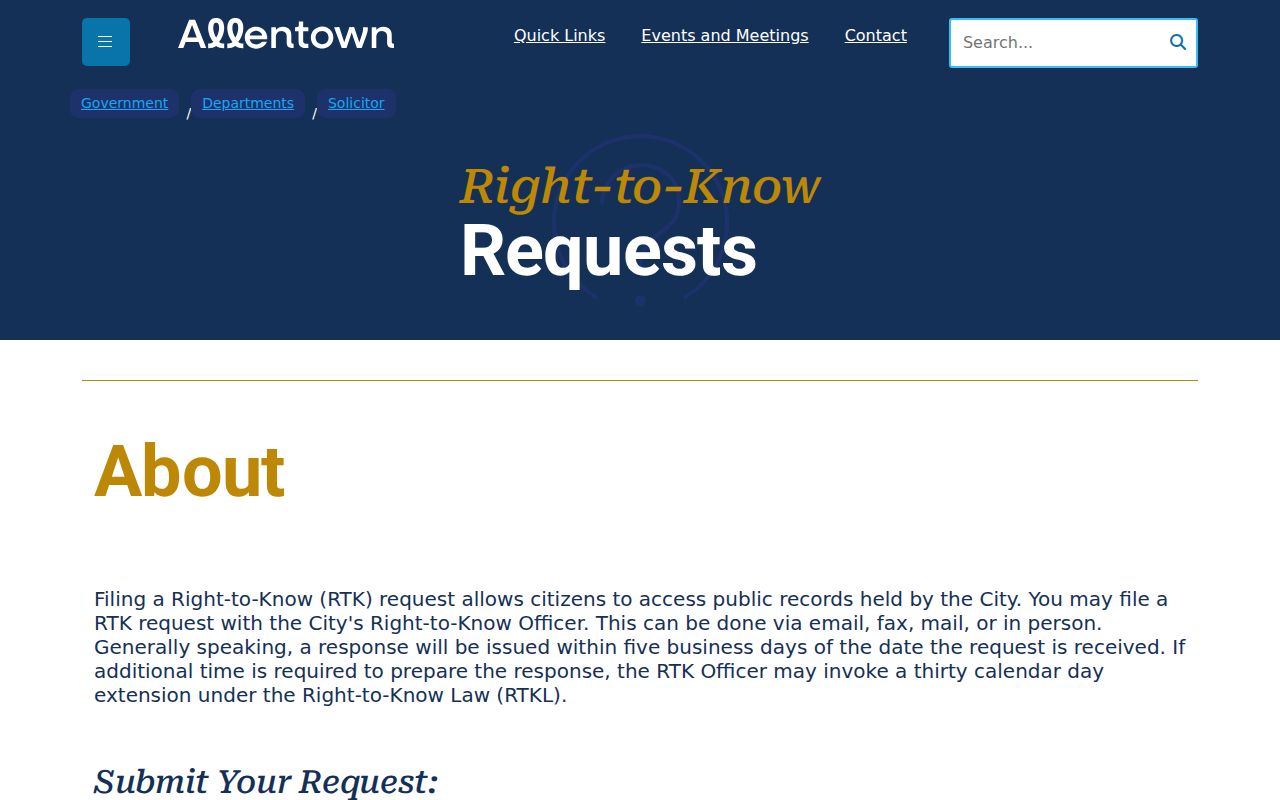
The city source directs an Allentown requester to the right custodian when the police counter cannot release the requested arrest-source material.
An Allentown request should describe an existing record, the agency, subject, date range, and preferred format. Allentown generally has five business days to respond, deny, or invoke a possible 30-calendar-day extension. Allentown police video and audio follow Pennsylvania Act 22, not the routine RTKL path. Criminal investigative appeals from Allentown go to the Lehigh County District Attorney rather than the ordinary statewide appeal route.
Allentown Municipal Court Records
Allentown does not operate a general-jurisdiction municipal criminal court. City criminal matters begin in Pennsylvania's Magisterial District Courts. Summary matters and preliminary stages may remain there, while felony and misdemeanor cases held for court move to the Lehigh County Court of Common Pleas, Pennsylvania's 31st Judicial District. The official UJS Case Search is therefore the online route for an Allentown complaint after filing.
| Court name | Magisterial District Court at the initial level; Lehigh County Court of Common Pleas for held-for-court cases |
|---|---|
| Case types heard | Summary matters, preliminary arraignments and hearings at the district level; felony and misdemeanor proceedings at Common Pleas |
| Case lookup channel | Unified Judicial System of Pennsylvania Web Portal Case Search |
| What the docket shows | Docket number, OTN, charges, grading, bail, events, status, disposition, sentence, and financial assessments as available |
| Copies and fees | Use the Clerk of Judicial Records Criminal Division for certified copies and public papers not reproduced online |
An Allentown docket entry is not always a downloadable document. Sealed and limited-access Allentown cases do not appear publicly, and confidential fields are restricted. For certified or older Allentown material, contact the clerk rather than asking APD to reproduce a court file.
Three Allentown Records Doors
Three Hamilton Street addresses explain much of Allentown's records geography. APD sits at 425 Hamilton Street. Allentown City Hall is next door at 435 Hamilton. The Lehigh County Courthouse is at 455 W. Hamilton Street. Their short physical distance can make the offices seem interchangeable, but each controls a different class of record.
Use APD for an eligible city police report. Use City Hall's Solicitor channel for Allentown Right-to-Know requests, including arrest reports or investigative supplements that do not qualify for the ordinary police counter. Use the courthouse and Clerk of Judicial Records Criminal Division for filed criminal cases, certified docket material, pleas, dispositions, and sentences. The Lehigh County Government Center at 17 S. Seventh Street handles county requests, not city APD files.
This Allentown corridor is useful for in-person research only after the correct custodian is known. A visit to the nearest Allentown counter may waste time if the requested record belongs to the next building or to a statewide system.
Where Allentown Records End Up
An Allentown incident starts with APD. When an arrest is fingerprinted, identifying and charge data go to the Pennsylvania State Police Central Repository. A criminal complaint starts at a Magisterial District Court. Felony and misdemeanor matters held for court move to the Lehigh County Court of Common Pleas, where the Clerk of Judicial Records Criminal Division maintains the Common Pleas docket. Courts then report dispositions to the state repository.
Record flow: Allentown Police Department › Lehigh County Courts › Pennsylvania State Police Central Repository
The Allentown flow tells a searcher where to look by age and purpose. APD is closest to a new Allentown incident. UJS and the clerk show the filed Allentown case and judicial outcome. PATCH supplies a Pennsylvania repository certificate, but not the Allentown police narrative or full court file. A delayed or missing disposition can be checked against the UJS docket and certified clerk papers.
Allentown Complaint Search in UJS
The strongest link between an APD record and a court case is often the OTN, or Offense Tracking Number. UJS Case Search also accepts a police incident or complaint number. Those identifiers are safer than relying on a common name alone. Choose the Magisterial District Court or Court of Common Pleas search, set the county to Lehigh, and use the most precise number on the paperwork.
The official Pennsylvania UJS Case Search requires no account for public docket searches. Results can show the county, court, filing date, status, charge grades, bail, scheduled events, docket entries, disposition, sentence, and costs. If the Allentown complaint has advanced from the district level, check for the Common Pleas docket tied to the same OTN.
An Allentown participant search can be useful when no number is known, but names can collide. Compare the Allentown arresting agency, date, county, OTN, and complaint number before treating two entries as the same Allentown matter.
Public Access Rules
Pennsylvania law separates city agency records, criminal-history compilations, court records, and police recordings. The Right-to-Know Law creates a route for qualifying Allentown agency records, but it does not override criminal-investigation exemptions, juvenile privacy, victim protections, sealed orders, or the rules governing criminal history record information. Judicial dockets follow court access policy, while repository dissemination is controlled by CHRIA.
Key Statutes:
18 Pa.C.S. §§ 9102 and 9121 define criminal history record information and govern its dissemination.
Pennsylvania Right-to-Know Law supplies the general agency-record request and appeal framework.
Pennsylvania court public-access policy governs access to judicial case records and confidential information.
Allentown may redact or withhold active investigative material, confidential sources, victim information, juvenile records, and evidence-sensitive details. An Allentown denial should identify the legal basis and appeal route. Allentown requests for police video or audio must follow Act 22 deadlines and procedures shown by the city.
Allentown CLEAN Record Audits
APD reports that Police Records performs monthly validation and auditing of entries in Pennsylvania's Commonwealth Law Enforcement Assistance Network, known as CLEAN. That detail shows the local data-quality work behind Allentown arrest-source records. It does not guarantee that every court result has reached every system at the same time. Police, court, jail, and repository files still have separate custodians and update cycles.
When an Allentown entry looks wrong, compare the Allentown APD incident or arrest identifiers with the UJS docket. For one's own complete Pennsylvania repository record, use the State Police Individual Access and Review process. Collect certified Allentown disposition papers from the Lehigh County clerk if a charge outcome is missing, then follow the State Police challenge process. A PATCH result marked "Under Review" is only a possible identifier match awaiting manual review, not proof that an Allentown criminal record exists.
This comparison is also important after expungement or an order for limited access. The order and each official system may not change on the same day, so verify the court docket and repository response independently.